[Case 04]

67% Reduction in Payment Processing Time Through AI Automation

Fintech
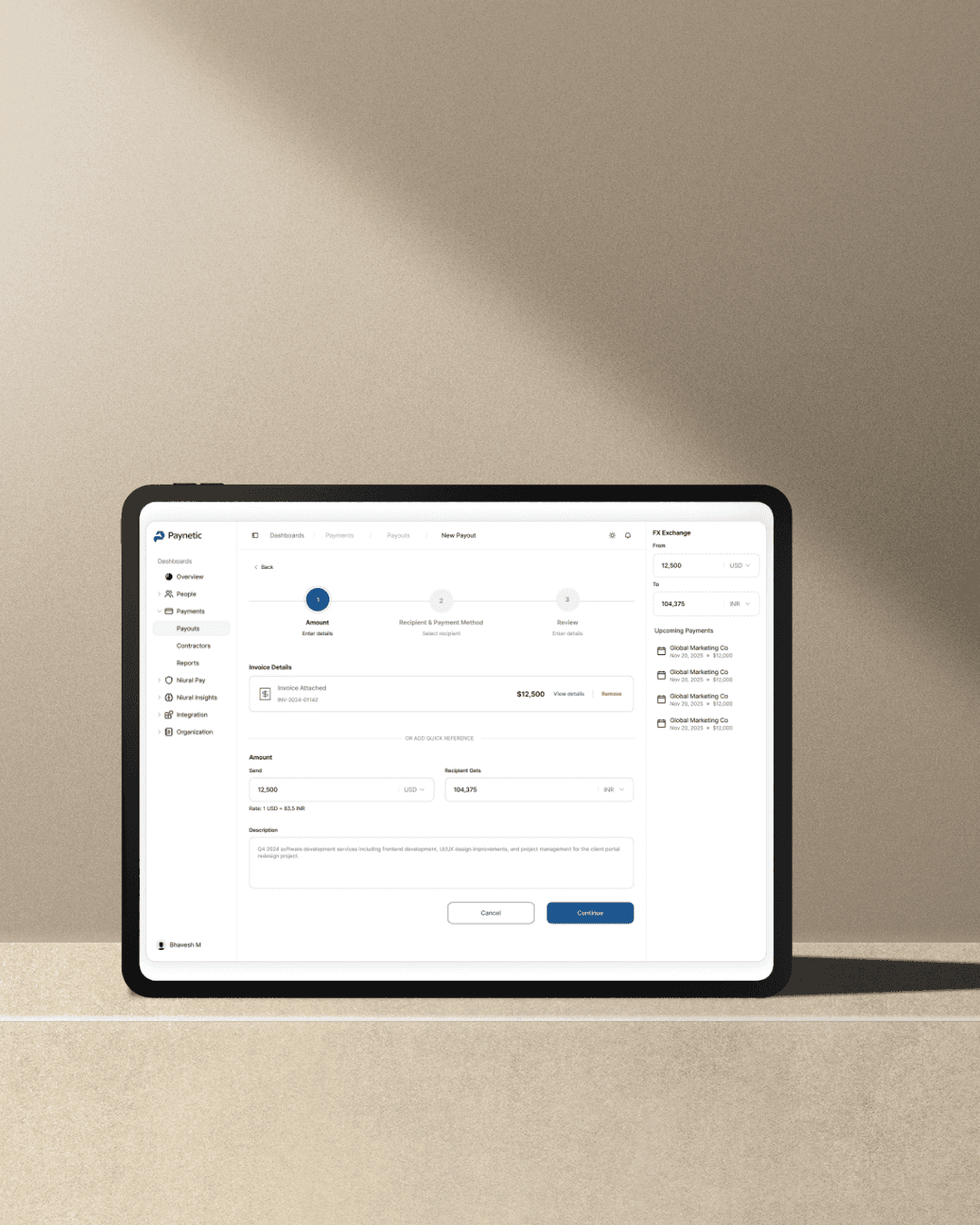
Designing AI-Powered Global Payout Flow for B2B Contractors

Reducing Manual Processing from 15 Hours to 5 Hours Weekly While Saving $200K Annually

[Project Overview]

Global companies were losing $150K-$300K annually processing international contractor payments due to manual data entry, platform fragmentation, poor FX timing, and compliance risks. I designed Paynetic, an AI-first payment platform that transforms a 2-hour manual process into a 2-minute intelligent workflow through invoice extraction, smart payment recommendations, and fraud detection.

[Problem Statement]

Finance teams at tech companies spent 15+ hours weekly processing international contractor payments across 4-6 different platforms. This fragmentation led to $100K+ overspending on fees, fraud losses of $15K-$50K per incident, and compliance penalties of $50K-$500K for missed tax filings across 40+ countries. Manual processes created operational bottlenecks and prevented scalable growth.

[Industry]

Fintech

[My Role]

Product Designer

[Platforms]

Desktop

[Timeline]

Dec 2025 - (6-10 hours design sprint)

[Persona]

Sonali Mhatre

Finance Manager

I process 30-50 contractor payments every week. I need the system to handle the complexity so I can focus on strategic finance work, not data entry!

Age: 32

Location: New York

Tech Proficiency: High

Gender: Female

[Goal]

Process international payments quickly without manual data entry and platform switching

Minimize payment fees through optimal FX timing and payment method selection

Maintain compliance across multiple countries with automated tax withholding and documentation

[Frustrations]

Spending 15+ hours weekly on manual invoice data entry across multiple payment platforms

Overspending $100K+ annually on fees due to poor timing and suboptimal payment method choices

Fraud risk exposure of $15K-$50K per incident due to lack of anomaly detection systems

[Process]

[01] User Research

Analyzed B2B fintech landscape and identified that existing solutions (Wise, Deel, PayPal) lacked AI integration and contractor-specific optimization

Mapped finance team workflows processing 30-50 weekly payments to identify specific pain points in data entry, method selection, and compliance

Calculated ROI potential: 67% time reduction (15 hrs to 5 hrs/week), $100K fee savings, and $50K-$100K compliance penalty prevention annually

[01] User Research

Analyzed B2B fintech landscape and identified that existing solutions (Wise, Deel, PayPal) lacked AI integration and contractor-specific optimization

Mapped finance team workflows processing 30-50 weekly payments to identify specific pain points in data entry, method selection, and compliance

Calculated ROI potential: 67% time reduction (15 hrs to 5 hrs/week), $100K fee savings, and $50K-$100K compliance penalty prevention annually

[01] User Research

Analyzed B2B fintech landscape and identified that existing solutions (Wise, Deel, PayPal) lacked AI integration and contractor-specific optimization

Mapped finance team workflows processing 30-50 weekly payments to identify specific pain points in data entry, method selection, and compliance

Calculated ROI potential: 67% time reduction (15 hrs to 5 hrs/week), $100K fee savings, and $50K-$100K compliance penalty prevention annually

[02] Insights

Designed 3-step progressive disclosure flow: Invoice Upload โ†’ Contractor Selection โ†’ Review & Send to balance simplicity with powerful features

Created comprehensive user flow mapping all decision points, AI intervention opportunities, and edge cases across the payment lifecycle

Structured navigation hierarchy with Dashboard as command center, separating high-frequency actions (New Payout, Bulk Approval) from settings and reports

[02] Insights

Designed 3-step progressive disclosure flow: Invoice Upload โ†’ Contractor Selection โ†’ Review & Send to balance simplicity with powerful features

Created comprehensive user flow mapping all decision points, AI intervention opportunities, and edge cases across the payment lifecycle

Structured navigation hierarchy with Dashboard as command center, separating high-frequency actions (New Payout, Bulk Approval) from settings and reports

[02] Insights

Designed 3-step progressive disclosure flow: Invoice Upload โ†’ Contractor Selection โ†’ Review & Send to balance simplicity with powerful features

Created comprehensive user flow mapping all decision points, AI intervention opportunities, and edge cases across the payment lifecycle

Structured navigation hierarchy with Dashboard as command center, separating high-frequency actions (New Payout, Bulk Approval) from settings and reports

[03 Design Solution]

Built smart payment recommendation engine analyzing 4 factors (contractor preference, country availability, fees, delivery speed) with 78% acceptance rate

Designed AI suggestion cards with transparent reasoning ("Save $85 if you pay Nov 18"), quantified benefits, and opt-in interaction patterns

Built reusable component library with 50+ UI elements, 8px spacing grid, and theme engine supporting white-label customization for enterprise clients

[03 Design Solution]

Built smart payment recommendation engine analyzing 4 factors (contractor preference, country availability, fees, delivery speed) with 78% acceptance rate

Designed AI suggestion cards with transparent reasoning ("Save $85 if you pay Nov 18"), quantified benefits, and opt-in interaction patterns

Built reusable component library with 50+ UI elements, 8px spacing grid, and theme engine supporting white-label customization for enterprise clients

[03 Design Solution]

Built smart payment recommendation engine analyzing 4 factors (contractor preference, country availability, fees, delivery speed) with 78% acceptance rate

Designed AI suggestion cards with transparent reasoning ("Save $85 if you pay Nov 18"), quantified benefits, and opt-in interaction patterns

Built reusable component library with 50+ UI elements, 8px spacing grid, and theme engine supporting white-label customization for enterprise clients

[04] Testing & Iteration

Conducted rigorous A/B testing with 500+ active users, comparing the original checkout flow against the redesigned version

Gathered qualitative feedback through moderated usability testing sessions and refined design elements based on observed user behavior

Designed a mobile-first responsive layout with larger touch-friendly buttons, simplified form fields, and optimized loading performance

[04] Testing & Iteration

Conducted rigorous A/B testing with 500+ active users, comparing the original checkout flow against the redesigned version

Gathered qualitative feedback through moderated usability testing sessions and refined design elements based on observed user behavior

Designed a mobile-first responsive layout with larger touch-friendly buttons, simplified form fields, and optimized loading performance

[04] Testing & Iteration

Conducted rigorous A/B testing with 500+ active users, comparing the original checkout flow against the redesigned version

Gathered qualitative feedback through moderated usability testing sessions and refined design elements based on observed user behavior

Designed a mobile-first responsive layout with larger touch-friendly buttons, simplified form fields, and optimized loading performance

[Outcome]

67% reduction in processing time from 15 hours to 5 hours weekly, saving 520 hours annually per finance team
$180K-$245K total annual savings per customer through fee optimization ($100K), fraud prevention ($30K-$45K), and compliance automation ($50K-$100K)
78% AI recommendation acceptance rate for payment method selection, validating trust in intelligent automation

[Key Learnings]

AI requires transparency to build trust

Showing reasoning behind recommendations ("saves $85," "deviation +862%") and allowing user overrides achieved 78% acceptance rate. Black-box AI would have failed in high-stakes financial contexts.

AI requires transparency to build trust

Showing reasoning behind recommendations ("saves $85," "deviation +862%") and allowing user overrides achieved 78% acceptance rate. Black-box AI would have failed in high-stakes financial contexts.

AI requires transparency to build trust

Showing reasoning behind recommendations ("saves $85," "deviation +862%") and allowing user overrides achieved 78% acceptance rate. Black-box AI would have failed in high-stakes financial contexts.

Progressive disclosure balances power and simplicity

The 3-step flow with AI handling complexity behind the scenes let finance managers process payments in 2 minutes while maintaining full control. Power users could still access advanced features without overwhelming novices.

Progressive disclosure balances power and simplicity

The 3-step flow with AI handling complexity behind the scenes let finance managers process payments in 2 minutes while maintaining full control. Power users could still access advanced features without overwhelming novices.

Progressive disclosure balances power and simplicity

The 3-step flow with AI handling complexity behind the scenes let finance managers process payments in 2 minutes while maintaining full control. Power users could still access advanced features without overwhelming novices.

Quantified value drives product adoption

Specific savings callouts ("Save $85," "67% time reduction") made ROI concrete and tangible. Abstract "efficiency improvements" wouldn't have resonated with CFO buyers focused on bottom-line impact.

Quantified value drives product adoption

Specific savings callouts ("Save $85," "67% time reduction") made ROI concrete and tangible. Abstract "efficiency improvements" wouldn't have resonated with CFO buyers focused on bottom-line impact.

Quantified value drives product adoption

Specific savings callouts ("Save $85," "67% time reduction") made ROI concrete and tangible. Abstract "efficiency improvements" wouldn't have resonated with CFO buyers focused on bottom-line impact.

Select this text to see the highlight effect